 Edgar de Wit
Forecasting often feels slow because we spend a lot of (our) time reconciling data, updating multiple versions, and navigating complicated approval processes. What makes forecasting take days instead of hours is the workflow behind it, where teams attempt to model every detail rather than focusing on what truly drives business outcomes.
Rolling forecasting becomes way more effective when we concentrate on the key operational drivers that actually influence results, rather than attempting to account for every minor variable. Nitpicking every detail rarely adds meaningful insight. By focusing on volumes, capacity, staffing, or revenue drivers, teams gain a clearer understanding of the business and can make better decisions without getting bogged down in excessive complexity. Simplicity in focus, rather than precision in minor details, is what accelerates updates and improves decision-making across the organisation.
What slows us down lots, is when the model’s underlying structure changes with each revision, requiring manual corrections and repeated mapping. (Oh, the joy!) Effective rolling forecasting workflows maintain a stable structure while keeping assumptions separate and super easy to adjust. Operational drivers, pricing assumptions, and staffing levels can be updated without modifying accounts, cost centres, or other structural elements. This separation ensures that refreshing the forecast is a quick task that can be done in a hot minute.
Traditional forecasting often produces multiple versions of the same model (v1, v2, final, etc.), which creates duplicated effort and confusion about which numbers to trust. Rolling forecasting uses a single continuous forecast with a moving horizon, where drivers naturally advance over time instead of being recreated for each version. This approach reduces redundant work, improves clarity and keeps the focus on the changes that truly matter for decision-making.
Forecast updates are really only useful when their effect is visible across related financial and operational outputs. Changes in assumptions should automatically flow through to cash flow, EBITDA, capacity planning, or staffing projections, ensuring that the impact of decisions is transparent in real time. When updates are delayed or disconnected from downstream reporting, the forecast loses its relevance and credibility, undermining the very purpose of rolling forecasting.
Rolling forecasting workflows often fail when every minor change triggers long approval cycles or when ownership of the model is unclear. Lightweight governance balances the need for flexibility with the requirement for control, ensuring that roles are defined, approvals are minimal but sufficient, and boundaries are clear. Teams can confidently update assumptions while management maintains oversight and accountability, keeping the process smooth and reliable.
In sports organisations, fluctuations in capacity and seasonal demand create continuous pressure on staffing and revenue projections, making fast updates essential. In healthcare, patient volumes, staffing needs, and regulatory requirements shift frequently, requiring forecasts to remain accurate and actionable. Teams that try to capture every detail in spreadsheets or disconnected files often fall behind. In contrast, workflows that maintain stable structure, focus on a limited number of drivers, and implement lightweight governance enable forecasts to be refreshed in minutes while remaining trustworthy.
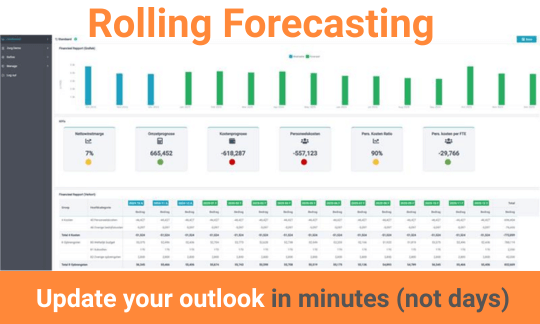
Rolling forecasting is not about more effort or more detail; it is about better structure, clearer assumptions, and a workflow that allows teams to update projections efficiently and reliably. When the model’s structure is stable, drivers move forward naturally, impacts are visible immediately, and governance is lightweight but effective, forecasts become a practical tool for decision-making rather than a time-consuming burden.
If updating your forecast still takes days, you are not actually rolling forecasting. Take a Demo Tour to see how a workflow designed around these principles allows finance teams to update forecasts quickly and make timely, informed decisions.
Back to the listSchedule a Meeting with one of our Planning and Reporting Experts.
Let's TalkXLReporting is an online Planning and Reporting Platform to create reports, budgets and forecasts the way you want.


© 2009-2026 XLReporting
® All rights reserved
