 Edgar de Wit
In many manufacturing organisations, forecasting becomes more detailed every year. Extra cost categories are added, new assumptions are introduced, and additional spreadsheets are built to connect operational data to financial results. The model expands, but that does not automatically make it easier to understand or use. Many businesses already have plenty of production data in their ERP systems. Exact or Twinfield provide reliable actuals, and costs are carefully tracked. Yet forecasts move slowly, margins remain hard to explain, and scenario discussions often feel a bit abstract. Clear, understandable production drivers can make all the difference.
Production drivers go beyond ERP mechanics. They reflect management choices about what truly explains financial performance.
Starting a model with revenue targets or cost budgets instead of volume disconnects planning from reality. Revenue comes from units multiplied by price. Costs follow the flow of units and the structure of production capacity. Management must communicate the expected production before discussing financial outcomes. Revenue and costs then follow logically.
Keeping price separate from volume makes it easier to discuss commercial positioning and production planning independently. Forecasting improves when these discussions stay distinct. Changes in selling price can be assessed without altering production assumptions. Changes in production volume can be analysed without being hidden as a pricing issue. Clear drivers make assumptions traceable. Management can ask focused questions: is margin pressure coming from lower volumes, pricing, or cost behaviour?
Manufacturing costs rarely fit neatly into fixed or variable categories. Materials track volume closely. Labour may follow production within certain ranges. Overhead includes both activity-linked costs and structural capacity. Making these layers explicit ensures financial planning reflects operational reality. Flexibility is grounded in how costs actually behave. Overhead tied to capacity doesn’t disappear just because production slows.
A driver-based model only works if it can be explained clearly. When production logic spans dozens of assumptions understood by only one person, ownership disappears. Readable drivers let management see the link between operational plans and financial outcomes instantly. If the logic behind volume, price, and cost layers can’t fit on a single page, the model is probably too detailed to guide decisions.
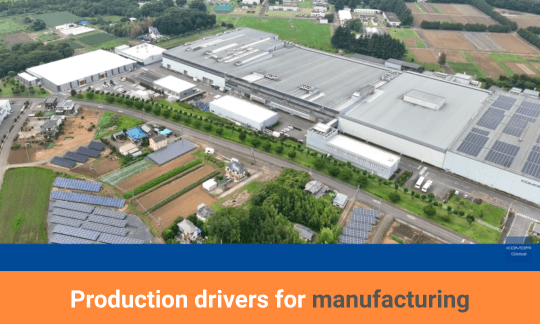
At companies like Komori International, production drivers form the backbone of a rolling 12-month forecast. Instead of a detailed central forecast trying to capture every operational nuance, they work with a limited set of clear drivers. Drivers are defined centrally to maintain consistency. Planning happens locally, where operational knowledge sits. Forecast adjustments happen close to the action, within a shared framework.
This shows a key principle: structure and ownership complement each other. Clear central drivers allow decentralised planning. With a manageable set of drivers, maintaining a 12-month forecast is possible without adding complexity.
Reliable actuals are essential for driver-based forecasting. Integrations with systems like Exact and Twinfield keep production and financial data consistent and up to date. When actuals flow automatically, management can focus on interpretation instead of data collection. AI Assist speeds up mapping and structuring of production and financial data. It helps align accounts and datasets with chosen drivers. AI doesn’t decide which drivers matter or optimise production, those decisions remain managerial. Its role is to make data usable within a clear structure.
Manufacturing organisations often have plenty of detail, but not enough prioritisation. Explicit production drivers force decisions about what truly explains results. When volume, price, and cost layers are clear and readable, forecasts update faster, scenario discussions become concrete and margin changes can be traced back to assumptions instead of hidden in opaque totals.
Production drives financial performance. A financial model should reflect that logic in a way management can understand and trust. If production drives your results, your financial model should reflect that. Book a Discovery Call to explore how production drivers can be simplified and structured.
Back to the listSchedule a Meeting with one of our Planning and Reporting Experts.
Let's TalkXLReporting is an online Planning and Reporting Platform to create reports, budgets and forecasts the way you want.


© 2009-2026 XLReporting
® All rights reserved
