 Edgar de Wit
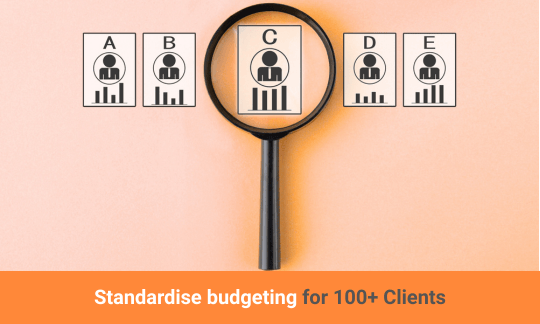
If every client budget starts from scratch, uses a different structure, and depends on individual spreadsheets, you're rebuilding the same logic over and over again. Knowledge stays locked inside files and inside people. A scalable budgeting service requires a clear structure that can be reused across clients. So we're not talking identical budgets, we're saying shared framework.
Within that structure, drivers and assumptions can differ per client. When structure is consistent, knowledge becomes reusable. Reviews become faster. Teams work in the same way across all clients:
Instead of budgeting every expense separately, the firm defines the core drivers that explain performance: Revenue drivers, capacity drivers, cost behaviour > so the logic becomes reusable. Whilst outcomes differ per client because inputs differ, the structure stays stable. This is where scale begins.
A budgeting structure represents knowledge. It reflects how the firm thinks about revenue logic, cost behaviour, margin development, and planning cycles. That structure is intellectual property. When this knowledge remains buried in individual files, it cannot be reused. When it is captured centrally, it becomes scalable.
The question shifts from: “How do we build this budget?” To: “How do we design a structure we can use 100 times?”
Many firms still own the entire budgeting process. They collect input, adjust numbers, fix formulas, and resend files. The client waits. The firm updates. The cycle repeats. Budgeting becomes a communication workflow instead of a financial service.nA scalable model introduces a clear shift: From accountant-owned budgets to client-owned input within a controlled structure. This defines the structure and logic centrally; Clients provide and adjust their own input within that framework. Accountants focus on review, guidance, and quality control.
OZCAR, a partner serving many clients in the cultural sector, faced a familiar situation. Budgeting was handled entirely in Excel. Every change required back-and-forth emails, new file versions, and manual updates. Over time, the real challenge was no longer financial modelling. It was coordination. The turning point came when they moved away from accountant-owned spreadsheets toward a standardised budgeting structure with client-owned input. The structure became central and reusable and clients worked within defined boundaries.
Integrations enable consistency When firms work across many clients, they need to have a consistent flow. A shared way of structuring budgeting ensures that data flows in the same way for every client. So less manual handling and easier updates so revisions require less coordination. Integrations support this consistency. They remove repetitive data handling and allow firms to focus on interpretation instead of administration. Technology enables scale. Structure makes it possible.
Moving from custom delivery to a scalable service requires clear choices. What is generic? What is client-specific? Which logic should be captured once and reused many times? Partner enablement support helps firms answer these questions. It accelerates the transition from individual project work to a structured service model. When budgeting does not scale, firms often assume they need more capacity. More people. More hours. But the real constraint is structural because if every budget is custom, growth will always depend on additional manual effort.And you can’t scale custom budgets.
See where your budgeting service can be standardised without losing quality: Start with a Quick Scan.
Back to the listSchedule a Meeting with one of our Planning and Reporting Experts.
Let's TalkXLReporting is an online Planning and Reporting Platform to create reports, budgets and forecasts the way you want.


© 2009-2026 XLReporting
® All rights reserved
